
Most founders assume software succeeds or fails after launch. They point to the first marketing campaign, the first paying customer, or the first disappointing sales report as the moment everything either comes together or starts to unravel.
In our experience, that’s rarely where the story begins.
Long before a product reaches the market, hundreds of decisions have already shaped its future. The architecture chosen. The assumptions made about customers. The problems prioritised, the features included, the positioning adopted. None of these decisions attracts much attention outside the team building the software, yet together they quietly determine whether a product is moving towards traction or towards an expensive lesson.
Here’s what makes this uncomfortable: the first version of a SaaS product is almost never constrained by engineering capability. Modern teams can build remarkably sophisticated systems in remarkably little time. The constraint is strategic. Engineering delivers what it’s asked to build — and if the early product decisions are flawed, excellent execution cannot compensate for building the wrong thing.
We’ve watched technically exceptional products fail because they solved problems customers didn’t care enough about. We’ve watched comparatively simple products win because they focused relentlessly on one genuine pain point and solved it with precision.
The difference is rarely talent. It’s direction.
The Post-Mortem Usually Blames the Wrong Thing
When a software product fails, the autopsy focuses on what’s visible;
- Marketing wasn’t effective enough.
- Funding ran out.
- Sales never gained momentum.
- A larger competitor moved in.
- The pricing was wrong.
All of these influence outcomes. Almost none of them are root causes. They’re symptoms.
By the time a SaaS product launches, its most important decisions have already been locked in. The audience has been chosen. The feature set has been defined. The positioning has been established. The architecture has been designed around assumptions that may or may not be true. From that point on, every new feature, campaign and customer conversation is built on top of those earlier choices — and changing direction becomes progressively more expensive.
A weak foundation is very difficult to market your way out of. Worse, the more a company invests in the wrong direction, the harder it becomes to admit the direction itself is the problem.
Successful products rarely succeed because they had flawless launches. They succeed because, in the months before launch, they asked better questions than everyone else.
Failure Starts With Assumptions Nobody Tested
Every product begins with assumptions. That’s unavoidable, and it isn’t the problem.
A founder assumes that people experience a particular problem. That they care enough to solve it. That they’ll pay for a solution. That they’ll prefer this approach over that one. That they’ll immediately understand the value on offer. Some of these assumptions are visible; others stay hidden until real customers expose them.
The problem is treating assumptions as facts rather than as hypotheses that need testing. Many products are built as though their founding beliefs have already been proven — and founders become emotionally attached to their own reading of the problem. The longer that reading goes unchallenged, the harder it becomes to recognise contradictory evidence when customers eventually provide it.
Validation isn’t about confirming that your idea is brilliant. It’s about discovering where your thinking is incomplete while the discovery is still cheap.
Building Has Become Cheap. Learning Hasn’t.
Over the last decade, the cost of building software has collapsed. Frameworks have matured. Cloud infrastructure is affordable. Design systems accelerate front-end work, and AI now lets teams produce in weeks what once took months.
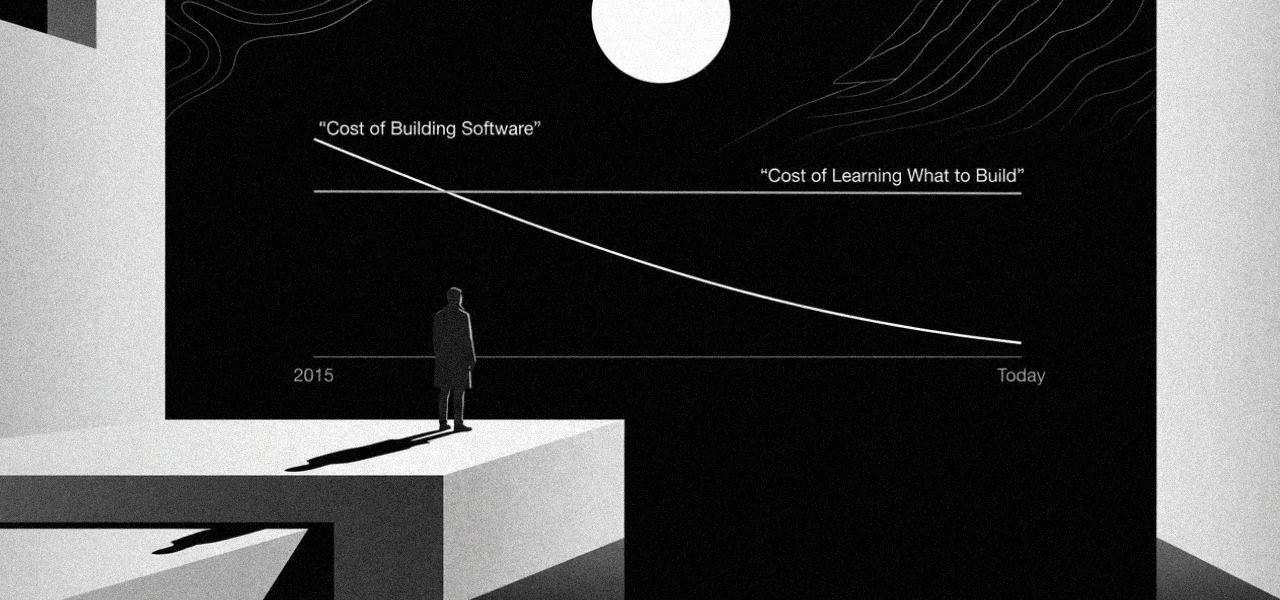
Customer discovery still requires conversations. Research still requires patience. Watching real workflows still surfaces insights no analytics dashboard can reveal. No framework, language or AI model can tell you whether people genuinely want the product you’re building.
This creates a trap. The faster software becomes to develop, the stronger the temptation to skip the uncomfortable work of validation — because building feels like progress. Features ship. Sprints close. Commits merge. The team is visibly moving.
But shipping the wrong features quickly isn’t progress. It’s efficient waste.
We’ve seen teams spend months building sophisticated capabilities that customers barely touched, while the one feature users genuinely cared about sat underdeveloped. The engineering was excellent. The velocity was impressive. The direction was wrong — and no amount of velocity fixes that.
An extra week spent validating an assumption can save months of rebuilding later. Execution matters. Direction matters first.
Falling in Love With the Solution
The most common pattern we encounter is a founder arriving with a solution before they’ve fully explored the problem.
The conversation opens confidently:
“We’re building an AI-powered dashboard.”
“We’re creating a platform that automates…”
The technology is fluently described. The feature set is taking shape. There may be wireframes and a roadmap. But shift the conversation to the customer and the certainty starts to fade. What exactly is frustrating them today? How are they solving this now? What have they already tried? Why didn’t it work?
Those questions are almost always harder to answer than questions about architecture — because technology isn’t the product. The customer’s outcome is.
Nobody buys software because of the framework it’s built on or the model powering it. They buy it because it lets them do something they couldn’t do before, or makes an existing task easier, faster, cheaper or less stressful. The best product discussions we’ve been part of spend surprisingly little time on features at all. They dwell on workflows, frustrations and outcomes — and the right features fall out of those conversations naturally. Starting with features and working backwards rarely produces the same clarity.
Technology evolves quickly. Customer problems persist for decades. Anchor to the one that lasts.
The Quiet Cost of “Just One More Feature”
Every founder planning a first release meets the same fear: what if customers think it doesn’t do enough?
So features accumulate. Reporting, notifications, permissions, integrations, analytics, customisation, mobile apps, API access. Each addition feels reasonable in isolation. None seems significant enough to cut. And gradually, the product transforms from a focused solution into a platform trying to satisfy every possible scenario.
The irony is that this makes the product harder to sell, not easier. Customers don’t evaluate software by counting features.
They ask one question:
“Will this solve my problem?”
If the answer is immediately obvious, the sale is straightforward. If answering it requires five minutes, several diagrams and a comparison chart, the product is trying to do too much.
Some of the strongest SaaS businesses are, on inspection, surprisingly narrow. They do fewer things than their competitors — they simply do those things exceptionally well. And that focus pays out across the entire business:
| Broad Product | Focused Product |
|---|---|
| Difficult to explain | Easy to understand |
| Longer development cycles | Faster validation |
| Higher maintenance costs | Simpler engineering |
| Larger support burden | Clear customer expectations |
| More edge cases | More predictable user experience |
Every feature carries a cost long after the initial build: more interface complexity, more testing, more support requests, another component to maintain for years. Customers are rarely impressed by complexity. They’re impressed by products that remove complexity from their own lives.
Simplicity isn’t the absence of capability. It’s the evidence of disciplined decisions about what doesn’t belong.
Building for Everyone Means Building for Nobody
The same fear that inflates feature sets also inflates audiences.
“Our software is for businesses.”
Technically true. Strategically useless. Which businesses? How large? At what stage? How do they work today, and under what constraints?
A five-person startup buys software very differently from a multinational. Different budgets, different approval processes, different priorities, different tolerance for complexity. Even their problems may only look similar on the surface. A product built to satisfy all of them usually satisfies none of them particularly well.
The strongest SaaS products almost never begin by serving everyone. They develop a deep understanding of one specific audience, solve that audience’s problems exceptionally well, and expand into adjacent markets only once that foundation holds.
Narrowing your focus doesn’t shrink your opportunity. It’s what makes the opportunity winnable.
Strategic Debt: The Kind You Take On Before Writing Code
Technical debt gets plenty of attention — the rushed implementations, the duplicated code, the temporary fixes that quietly become permanent.
There’s another form of debt that’s discussed far less and often does more damage: strategic debt. It accumulates every time a difficult decision is postponed.
“We’ll decide our pricing later.”
“We’ll work out our positioning after launch.”
“We’ll improve onboarding in Version Two.”
Deferred decisions don’t disappear. They compound — becoming steadily more expensive to revisit as more of the business is built on top of them.

And just as thoughtful architecture reduces engineering complexity, thoughtful strategy reduces business complexity. Clear positioning makes marketing easier. A well-defined audience simplifies every product decision. Strong validation prevents expensive pivots.
Good software isn’t built on code alone. It’s built on thousands of strategic decisions that quietly shape everything that follows.
The Cheapest Research You’ll Ever Ignore
Many founders avoid customer interviews because they don’t feel productive. Building produces visible results — features appear, interfaces improve, progress can be demonstrated. Conversations are unpredictable, sometimes awkward, often inconclusive.
Yet they consistently produce insights no dashboard, AI tool or brainstorming session can uncover.
The objective is not to persuade anyone your idea is brilliant. It’s to understand how they think, where they struggle, and why they behave the way they do. The most valuable questions are disarmingly simple:
- What are you doing today instead?
- What’s the most frustrating part of that?
- What have you already tried?
- Why didn’t it work?
- What would make this worth paying for?
Notice what’s absent. No pitching. No demo. No leading the customer towards the answer you want to hear.
Good discovery isn’t about collecting compliments. It’s about surfacing uncomfortable truths while they’re still inexpensive to act on. Customers will rarely describe the solution you should build — but they are exceptionally good at describing the problems they live with every day.
Learning to keep those two conversations separate is one of the most valuable skills a product team can develop.
Product-Market Fit Isn’t a Finish Line
Product-market fit is often treated as a milestone: work towards it, celebrate it, move on to growth.
It’s far less permanent than that. Markets evolve. Expectations shift. Competitors introduce new ideas. Technology reshapes entire industries. A product that fits the market today can be quietly drifting out of fit a year from now.
That’s why the strongest software companies never treat validation as something that ends when paying customers arrive. Launch isn’t the conclusion of validation — it’s the point at which validation becomes continuous. Every support conversation, feature request, cancellation and interview is another opportunity to learn.
The companies that stay relevant are rarely the ones that guessed correctly once. They’re the ones still learning long after everyone else believes they’ve found the answers.
None of This Excuses Poor Engineering
It would be easy to read this as an argument that engineering is secondary. It isn’t.
Poor reliability destroys trust. Weak security creates risk a young company can’t afford. Slow performance kills adoption. Fragile architecture makes every future release slower and more expensive than the last.
Product strategy and engineering are not competing priorities; they depend on one another. Thoughtful strategy can’t excuse careless engineering, and exceptional engineering can’t rescue a product nobody needs.
At Plus±, we design software for longevity rather than for launch day. That doesn’t mean enterprise-scale infrastructure from day one, or over-engineering components before a single customer arrives. It means making sensible architectural decisions that let a product grow without repeatedly rebuilding its foundations.
Good engineering isn’t about preparing for millions of users on day one. It’s about avoiding unnecessary rewrites on day one hundred.
What We Look For Before We Build
Every product is different, and no checklist guarantees success. But before significant development begins, we want confidence in five fundamentals.
The problem is clearly defined.
Not just the proposed solution — the customer problem itself, understood before technology enters the conversation.
The audience is specific.
Not everyone. Someone. The more precisely the initial audience is defined, the easier every subsequent product decision becomes.
The value proposition is obvious.
A prospect should understand why the product exists within moments of seeing it. If the value needs a presentation, the positioning needs work.
Early feedback supports the direction.
Not hundreds of paying customers — a small number of meaningful conversations with the right people, which are worth more than any volume of superficial feedback.
Success can be measured.
Without defined outcomes, every future decision becomes subjective. Good teams know what success looks like before they start building towards it.
There’s a pattern behind this list worth naming. People assume experience produces certainty. We’ve found almost the opposite: the more experienced a team becomes, the more questions it asks before committing to expensive decisions. Not from lack of confidence — from having seen what unchecked assumptions cost once development is underway. Inexperienced teams rush towards answers because uncertainty feels uncomfortable. Experienced teams sit with it a little longer, gathering evidence and reducing risk before writing serious code.
That discipline doesn’t slow projects down. It prevents them from moving quickly in the wrong direction.
Your First Customer Isn’t Buying Software
It’s tempting to believe your first customer is purchasing a collection of features. They’re buying something scarcer.
They’re buying confidence.
Confidence that you’ll keep improving the product. That you’ll still exist in twelve months. That you understand the problem they’re trying to solve, and that your roadmap is driven by their needs rather than your assumptions. And — perhaps most of all — confidence that choosing you won’t become a mistake they have to explain to their own colleagues.
Software is rarely purchased on functionality alone. It’s purchased on confidence.
That confidence is built long before contracts are signed. It shows in your positioning, your product decisions, your onboarding, your documentation, and every interaction a prospect has with your business. Every thoughtful decision strengthens it. Every rushed one quietly erodes it.
The Real Lesson
Most SaaS products don’t fail because developers wrote poor code. They fail because they solved the wrong problem, targeted the wrong audience, or spent months building on assumptions nobody tested. The technology is rarely the weakest part of the product. The thinking that preceded it usually is. Building the right product well will almost always outperform building the wrong product perfectly.
Launching software has never been easier, and it will keep getting easier. What won’t get easier is understanding what customers genuinely need. That still requires curiosity, conversation, observation, and the willingness to challenge your own assumptions before customers do it for you — publicly, and at your expense.

The companies that consistently build successful products aren’t the ones with the largest teams, the biggest budgets or the fastest release cycles. They’re the ones that learn faster than their competitors — spending less time falling in love with their own ideas and more time understanding the people they serve.
That learning begins long before the first line of code. And it never really ends.
Continue the Conversation
If you’re planning a new SaaS product — or questioning whether an existing one is solving the right problem — the highest-leverage investment you can make is validating assumptions before building more features.
At Plus±, the strongest software products come from thoughtful product strategy, careful engineering and a genuine understanding of customer needs. Technology is only one part of a successful product. Knowing what to build, who it’s for and why it matters is what creates lasting value.
If that philosophy resonates, explore how we approach product strategy, design and software development — or read more of our writing on SaaS, engineering and building products designed to last.