
Ask most founders where privacy sits in their product and you’ll get an answer that involves a lawyer, a cookie banner, and a policy page nobody has read since the day it was published. Privacy, in this framing, is a cost centre. Something you do to the product, reluctantly, so you can operate in Europe.
That framing made sense a decade ago. It’s ageing badly.
We’re seeing privacy move from the legal department into the product itself. Not as a slogan, but as a competitive advantage customers increasingly recognise — and can actually feel.
The companies noticing this early are treating privacy the way they treat performance or reliability: as a feature that compounds.
The companies noticing it late will spend the next few years retrofitting trust into products that were architected to extract.
Compliance is the starting line
It’s worth being precise about what regulation does and doesn’t do.
GDPR, CCPA, and their growing family of siblings define the minimum acceptable standard for handling personal data. They exist to punish the worst behaviour, not to reward the best. Meeting them earns you the right to operate — nothing more. Nobody has ever chosen a product because its cookie banner was compliant.
This is the trap in treating privacy as a compliance exercise: compliance is, by definition, the thing all of your competitors also have. A shared baseline can’t differentiate anyone. It’s the entry fee, not the game. Compliance tells your lawyers you’re safe — it tells your customers nothing.
Differentiation starts where regulation stops — in the decisions no law requires you to make. Choosing not to collect a field. Choosing to encrypt something you could legally store in plaintext. Choosing defaults that favour the user when nobody would have noticed if you hadn’t. These decisions are invisible to a regulator and increasingly visible to a buyer.
Trust is becoming a product feature
Something has shifted in how people evaluate software, and it’s easy to miss if you’re only watching feature comparisons.
Buyers — especially technical buyers — have been through enough breach notifications, dark-pattern consent flows, and quiet policy changes to have developed a working scepticism. They’ve watched products they relied on get acquired and repurposed as data assets. When they evaluate a new tool now, part of what they’re evaluating is what this company will do with what it learns about us.
This shows up in concrete ways. Procurement questionnaires that go far beyond the checkbox. Engineers reading your docs to see whether your architecture matches your marketing. Founders asking, before anything else, where the data lives and who can read it. In our experience, these questions arrive earlier in the sales conversation every year — and for a growing set of customers, a vague answer ends the conversation.
The interesting property of trust is that it behaves like compound interest with an asymmetry attached. It accrues slowly — through consistent behaviour, honest defaults, and a track record of not surprising people — and it can be spent in an afternoon. One incident, one quietly reworded policy, one “we’ve updated our terms” email that lands wrong. Rebuilding from that position costs far more than building carefully from the start ever would have.
This asymmetry is exactly why trust differentiates. It can’t be added in a sprint. A competitor can copy your feature in a quarter; they can’t copy three years of behaving well.
Every field you collect is a promise
Here’s a reframe we’ve found useful when designing software: data isn’t an asset until it’s earning something. Until then, it’s a liability you’re paying to keep.
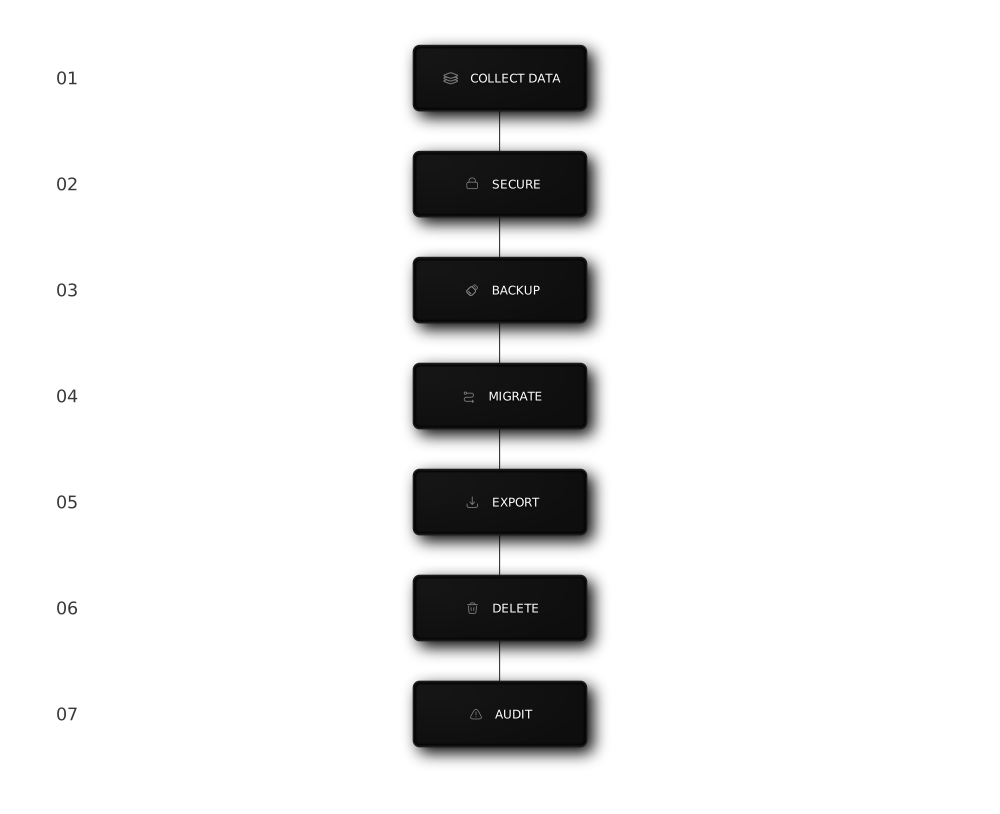
Every piece of personal data you collect carries obligations that outlive the moment of collection. It has to be secured, backed up, migrated through every schema change, included in every export request, scrubbed on every deletion request, and accounted for in every audit and every breach assessment. It expands what you have to defend and enlarges what a single mistake can expose. The database column costs nothing; the promise attached to it costs forever.
Seen this way, the instinct to collect everything “because we might need it later” starts to look less like optionality and more like unexamined risk. A common mistake is treating data collection as free and data deletion as the decision that needs justifying. Mature teams flip that: collection is the decision that needs a reason.
And this connects to something we’ve written about before — Every Feature Has a Maintenance Cost — because data has a maintenance cost too, and it’s usually invisible on the day you add the field. The analytics event nobody looks at. The optional profile fields that exist because the form template had room. The logs retained indefinitely because nobody chose a retention period. None of these are earning anything. All of them are accruing obligation.
Less data can mean better software
The pleasant surprise, when teams start collecting deliberately, is that the product usually gets better — not just safer.
Some of what we’ve seen fall out of privacy-first decisions:
Simpler onboarding. Every field you don’t ask for is friction removed. The shortest signup form is the one that only requests what the product genuinely needs to function — which, examined honestly, is usually far less than the form currently asks for.
Cleaner architecture. When sensitive data is minimised and clearly bounded, systems get easier to reason about. You know exactly where the sensitive material lives, which paths touch it, and what needs protecting. Sprawling data models where personal information leaks into logs, caches, and analytics pipelines are harder to secure precisely because nobody can draw the boundary.
Better defaults. Privacy-first thinking forces a useful question: what should happen when the user does nothing? Products designed around respectful defaults tend to need fewer settings, fewer consent interruptions, and less explanatory UI — because there’s less to opt out of. That restraint reads as confidence. It’s part of why good software doesn’t need explaining.
Fewer surprises. Products that ask for less rarely need awkward explanations later. Users don’t wonder why a note-taking app wants their location, or why a calendar asks for their contacts. Simplicity builds confidence before a single feature has been explored.
Honest analytics. Teams that can’t fall back on surveilling every click are pushed toward better questions: talking to users, measuring outcomes instead of behaviour, instrumenting the few things that actually inform decisions. Less data, more signal.
None of this is automatic — you can build a bad product that collects nothing. But the discipline of asking do we need this, and what do we owe the user if we take it? tends to produce the same qualities customers describe as “well built.”
Privacy is an architecture decision
The phrase “privacy by design” has been repeated enough to lose its edge, so let’s put it in practical terms: privacy decisions are cheapest on day one and get more expensive every day after.

Where data lives, how it’s keyed, what’s encrypted and with whose keys, what your systems can technically see — these are foundations. Retrofitting privacy into a system built around open access to everything isn’t a feature ticket; it’s often a partial rebuild, touching the schema, the permission model, and every integration that assumed it could read anything. This is why “we’ll tighten it up before launch” so rarely survives contact with a roadmap.
We say this from experience rather than principle. When designing our own client platform, we made end-to-end encryption a first decision, not a later hardening pass — client work, briefs, and communications are encrypted with keys we manage deliberately, and our infrastructure providers see ciphertext. That choice shaped the data model, the onboarding flow, even the copywriting around key recovery. It would have been dramatically harder to bolt on afterwards, and some of it would have been impossible without breaking things customers already relied on.
The point isn’t that every product needs end-to-end encryption — most don’t, and pretending otherwise is its own kind of dishonesty. The point is that the decision about what your systems should be able to see is a strategic one, and it belongs in the same early conversation as your stack and your business model. Deferred, it doesn’t disappear. It just gets quoted at a higher price later.
The cheapest privacy decision you’ll ever make is the one you make before writing code.
What it costs — because it does cost something
It would be dishonest to present any of this as free, and the articles that pretend otherwise are part of why “privacy-first” reads as marketing to a sceptical audience. So, plainly: privacy has trade-offs, and they’re worth naming before you commit to them.
Support gets harder. When your systems can’t read customer content, neither can your support team — debugging becomes a collaboration with the user rather than a quiet look at their account. Some features are simply off the table: you can’t build “we noticed you haven’t finished setting up” nudges from data you deliberately don’t hold. Recovery flows demand real design effort, because “reset your password and we’ll restore everything” assumes an access model you’ve chosen not to have. And there’s an organisational cost — every new hire, every integration, every tempting growth tactic has to clear a bar that most companies never set.
We’ve felt each of these on our own platform. They’re real, and occasionally inconvenient.
But notice what kind of costs they are. They’re the costs of keeping a promise, and customers can tell the difference between a company that pays them and one that doesn’t. A support process that works without reading your data is slower — and it’s also proof. In our experience, the trade-offs aren’t a weakness in the positioning. Handled openly, they’re the evidence for it.
The honest framing isn’t “privacy is free.” It’s that the costs are visible, bounded, and chosen — while the costs of the extractive default are invisible, unbounded, and usually discovered during an incident.
Where this is heading
We’d hedge any specific prediction, but the direction of travel seems clear enough to plan around.
Regulation will keep expanding — more jurisdictions, more categories of data, more teeth. AI has sharpened the question of what happens to data after it’s collected, and buyers have noticed that “we don’t sell your data” and “we don’t train on your data” are different sentences. Procurement is professionalising; security review is arriving earlier in more deals. And a generation of technically fluent buyers is developing the habit of reading the architecture, not the marketing.
In that environment, companies split into two groups: those explaining their data practices from a defensive crouch, and those for whom the explanation is part of the pitch. The second group gets to say something the first can’t — not “we comply,” but “we built it so we couldn’t misuse it if we wanted to.” That’s a stronger sentence in a sales conversation, a fundraise, or an acquisition — and it’s only available to companies that made the structural choices early.
“We comply with regulations” is a legal position. “We built it so we couldn’t misuse your data” is a competitive one.
Respect, operationalised
Strip away the regulation, the architecture, and the strategy, and privacy reduces to something simple: it’s respect for the people using your product, made operational. Collecting only what you need is respect. Honest defaults are respect. Building systems that can’t quietly betray their users is respect expressed in infrastructure.
Privacy used to be the thing you did so you could ship. Increasingly, it’s part of why people choose what you shipped.
Products quietly communicate the values of the people who build them. Over time, users come to recognise those values — not because they’re written on a landing page, but because they’re reflected in every interaction. Privacy is simply one of the clearest ways to demonstrate that respect.
At Plus±, we believe privacy is a structural decision, not a settings page. That’s how we build our own products, and it’s the philosophy we bring to every client project. If you’re exploring what that could look like for your own software, we’d love to talk. In the meantime, you’ll find more articles like this in the Plus± Journal.